
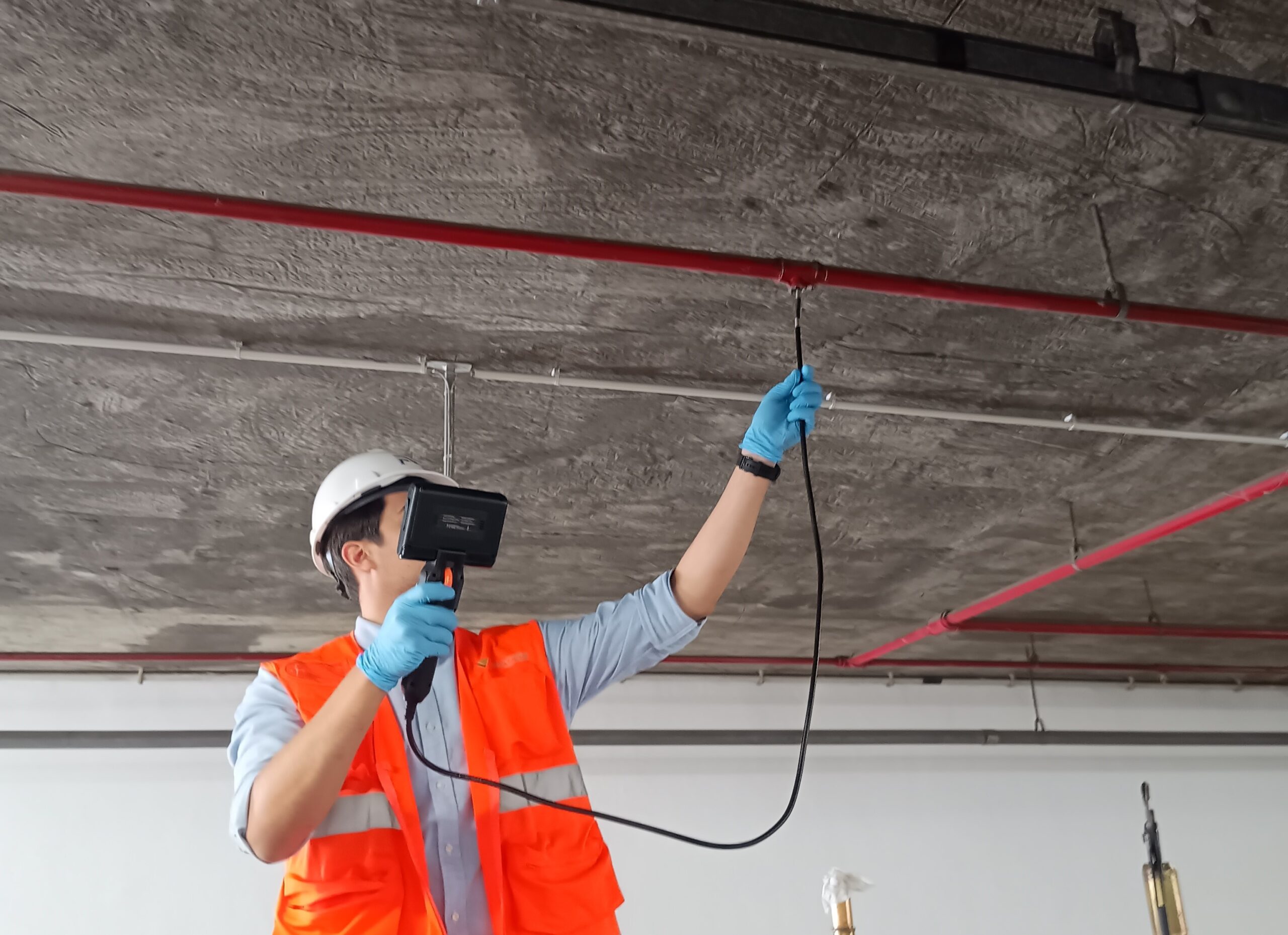
Pipe inspection
In addition to the inspection of sprinkler heads, the UNI EN 12845 standard requires that, every 25 years, the pipes of the sprinkler system also undergo a thorough inspection.
The 25-year sprinkler pipe inspection includes:
Internal and external visual inspection of the main pipes and branches;
For every 100 sprinkler, at least one meter of pipe in the branches and offshoots must be inspected;
For every diameter present, at least on meter per diameter of the pipes must be inspected.


Sprinkler head testing
Every 25 years, the UNI EN 12845 standard requires a functional test of the installed sprinkler heads , to verify their thermal response and hydraulic efficiency.
Unlike those who rely on external laboratories, Veryfire manages every phase of the test internallyto offer you speed, transparency, and quality.
The 25-year sprinkler test involves the removal and analysis of a representative number of heads, based on Table K.1 of the standard, to verify:
- ✅ Functional operation check (mechanical activation)
✅ Measurement of the actual K-factor
✅ Spray distribution control
✅ Inspection for corrosion, blockages, and housing defects
✅ Verification of operating temperature

F.A.Q
1.If I have fewer than 5,000 sprinkler heads, are 20 samples sufficient?
Yes, provided that they are all of the same type. Table K.1 states in the caption that the count is carried out by type.
2.In my client’s shopping mall, I have two types of sprinkler heads, pendent and upright. Is it correct to sample 40 heads if I have fewer than 5,000?
Yes, provided that there is no car park present. A car park constitutes a change in risk as well as in environmental conditions, which must be represented in the sampling. See the image below, which compares a sprinkler inside a shopping mall with one inside a car park. It is easy to see how the samples from the car park have been exposed to a more aggressive environment.


Consequently, if a car park is also present, the correct number is 60 sprinkler heads.
3.Some internal specifications propose testing 6 sprinklers instead of the 20 indicated by the standard. Can I consider the sampling to be adequate?
No. For the purposes of compliance with UNI EN 12845:2020, the sampling is not correct: Appendix K – Table K.1 explicitly establishes the minimum number of sprinkler heads to be removed and tested based on the installed population (ref. UNI EN 12845:2020, App. K, Table K.1). It is useful to clarify that these numbers are not arbitrary: they represent a target reliability level chosen by the standard setter. Using a binomial approach, the probability of not detecting failures is ( 1 − 𝑝 ) 𝑛 . Where p is the actual defect rate and n is the number of samples. With n = 6, even for p = 10%, the risk of not detecting any failures remains high (53%); by increasing the sample size, the risk is significantly reduced.

Any deviation from the standard-prescribed numbers must therefore be technically justified and undertaken under the responsibility of professionals with engineering training, with a clear acceptance of the residual risk.
4. How often must the inspection be repeated?
If the system successfully passes the first inspection after 25 years, it can be considered reliable for a further 25 years.
5. What are the main activities that Veryfire carries out during the inspection?
The inspection is divided into two main areas, as provided for in Appendix K:
Pipework inspection: measurement of the pipes using an ultrasonic thickness gauge and internal inspection with an industrial endoscope.
Sprinkler Head Testing: removal of a representative number of sprinkler heads and performance of the specific tests required by the standard at our laboratory.
6. What does the pipework inspection involve?
The pipework inspection, carried out by Veryfire, includes:
On-site inspection of at least one meter of piping for every 100 sprinklers installed on branch lines and extensions, and at least one meter for each pipe diameter present in the system. The inspection checks for the presence of internal/external corrosion, obstructions (biological or due to deposits), and the general condition of the material. Ultrasonic thickness gauges and industrial endoscopes are used.
The system may be subjected to hydrostatic tests to confirm its structural integrity.
7. What happens if the inspection outcome is positive?
If all pipework and sprinkler samples are found to be compliant and the integrity of the system is confirmed, Veryfire will issue a final Inspection Report certifying the system’s suitability to operate for the subsequent period, including any recommended improvement actions.
8. What happens if the inspection outcome is negative or non-conformities are identified?
In the event of a negative outcome (for example, extensive corrosion, significant obstructions, or sprinkler malfunction), Veryfire will identify the necessary corrective actions. Depending on the severity, corrective measures may range from partial replacement of the affected parts of the system (e.g. sprinkler heads or sections of piping) to the need for redesign or complete replacement of the entire system.
9. How does Veryfire support the client throughout all phases?
Veryfire supports the client throughout all phases of the process:
Planning: definition of the sampling plan and operating methods to minimize the impact on business activities.
Sampling: support to the system maintenance provider and identification of the sprinkler head sampling points.
Testing: assistance and support to the maintenance provider for on-site tests and full management of laboratory analyses on the sprinkler heads.
Final report: preparation of the Technical Report in every detail and signature by a Fire Safety Professional.
Consultancy: technical support in defining any post-inspection corrective actions